


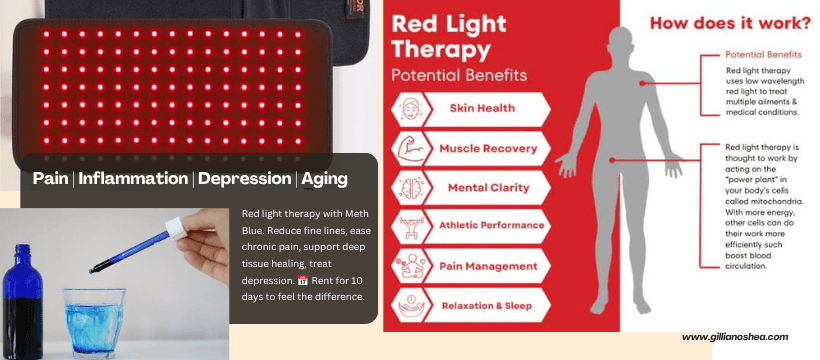
I have been using low dose Meth Blue together with red light therapy quite successfully on myself and clients. Using red light therapy (photobiomodulation) together with methylene blue (MB) has become an area of growing scientific interest because both appear to support mitochondrial energy production, but through different mechanisms. When used appropriately, they may have complementary effects.
The Mitochondria: Your Cells’ Power Stations
Every cell in your body (except red blood cells) contains mitochondria, tiny structures that produce ATP (adenosine triphosphate), the body’s energy currency.
When mitochondria become sluggish due to:
- chronic stress
- aging
- inflammation
- toxins
- infection
- poor circulation
- metabolic dysfunction
they produce less ATP and more harmful free radicals, contributing to fatigue and slower healing.
Both red light therapy and methylene blue aim to improve mitochondrial efficiency.
How Red Light Therapy Works
Red and near-infrared light (typically 630–850 nm) penetrates tissue and is absorbed by an enzyme called cytochrome c oxidase (Complex IV) within the mitochondrial electron transport chain.
This leads to:
✓ increased ATP production
✓ improved oxygen utilization
✓ better circulation
✓ nitric oxide release
✓ reduced inflammation
✓ stimulation of tissue repair
✓ improved collagen production
✓ reduced oxidative stress
Think of red light as helping the mitochondria work more efficiently.
How Methylene Blue Works
At very low doses, methylene blue acts almost like an “electron shuttle.”
Instead of relying solely on the normal electron transport chain, MB can:
accept electrons
donate electrons
bypass damaged portions of the mitochondrial chain
This means mitochondria may continue producing ATP even when parts of the system are functioning poorly.
MB also:
improves oxygen utilization
may reduce oxidative stress when used in appropriate low doses
has antioxidant properties at low concentrations
has antimicrobial properties under some conditions
has been studied for neuroprotection and cognitive support
Why They Work Well Together
Imagine mitochondria as a hydroelectric dam.
Red light opens the floodgates.
Methylene blue repairs broken turbines.
Together they may produce more electricity than either alone.
Scientifically:
Red light stimulates cytochrome c oxidase.
↓
Methylene blue improves electron transport.
↓
ATP production increases.
↓
Cells have more energy for repair.
↓
Healing processes improve.
1. Greater ATP Production
Research suggests both interventions increase ATP through different mechanisms.
The combination may produce greater mitochondrial efficiency than either treatment alone.
Higher ATP supports:
muscle recovery
brain function
hormone production
immune regulation
tissue healing
2. Reduced Oxidative Stress
Damaged mitochondria leak electrons. These become reactive oxygen species (ROS). Too much ROS contributes to:
inflammation
fatigue
accelerated aging
Low-dose methylene blue can reduce excess ROS, while red light therapy may stimulate the body’s own antioxidant defenses. Together, they may improve the balance between energy production and oxidative stress.
3. Improved Brain Function
Some early research suggests the combination may support:
memory
focus
mental clarity
cognitive performance
The brain uses enormous amounts of ATP. Supporting mitochondrial function may therefore improve mental performance.
4. Better Circulation
Both therapies appear to improve oxygen delivery.
Red light:
releases nitric oxide
improves blood flow
supports new capillary formation
Methylene blue:
can improve cellular oxygen utilization at low doses
This may help tissues receive and use oxygen more effectively.
5. Faster Healing
Higher ATP means cells repair themselves more efficiently.
Potential applications being studied include:
wound healing
muscle recovery
nerve regeneration
tendon repair
skin rejuvenation
6. Anti-Aging Potential
Aging is strongly linked with declining mitochondrial function.
Both therapies aim to restore healthier cellular energy production, which has led to interest in their use for healthy aging. While some early studies are encouraging, evidence for long-term anti-aging effects in humans is still limited.
7. Neuroprotection
Laboratory and early clinical studies have investigated methylene blue and photobiomodulation separately in conditions involving neurodegeneration, including research related to Alzheimer’s disease and Parkinson’s disease. Both approaches are being explored for their ability to support mitochondrial function and reduce oxidative stress.
The Synergy
Red Light Therapy Methylene Blue
Activates cytochrome c oxidase Acts as an electron carrier
Improves circulation Improves oxygen utilization
Releases nitric oxide Supports electron transport
Stimulates ATP Stimulates ATP
Reduces inflammation Helps limit oxidative stress at low doses
Promotes tissue repair Supports mitochondrial resilience
Together they may provide complementary support for cellular energy production.
Typical Clinical Sequence
Many integrative practitioners who combine these therapies will often:
Administer a carefully measured low dose of pharmaceutical-grade methylene blue.
Allow time for absorption.
Apply red or near-infrared light to the target area.
Encourage hydration and antioxidant-rich nutrition to support recovery.
*Important Safety Considerations:
This combination is not appropriate for everyone.
Methylene blue can:
interact with many antidepressants and other serotonergic medications, increasing the risk of Serotonin syndrome
cause hemolytic anemia in people with Glucose-6-phosphate dehydrogenase deficiency
interfere with pulse oximeter readings
Bottom line
The scientific rationale for combining red light therapy with low-dose methylene blue is strong because they target mitochondrial function through complementary mechanisms: red light helps stimulate mitochondrial enzymes, while methylene blue can facilitate electron transport within the energy-producing pathway.
Rent a red light therapy mat from me for 10 days to feel the difference.

Leave a comment